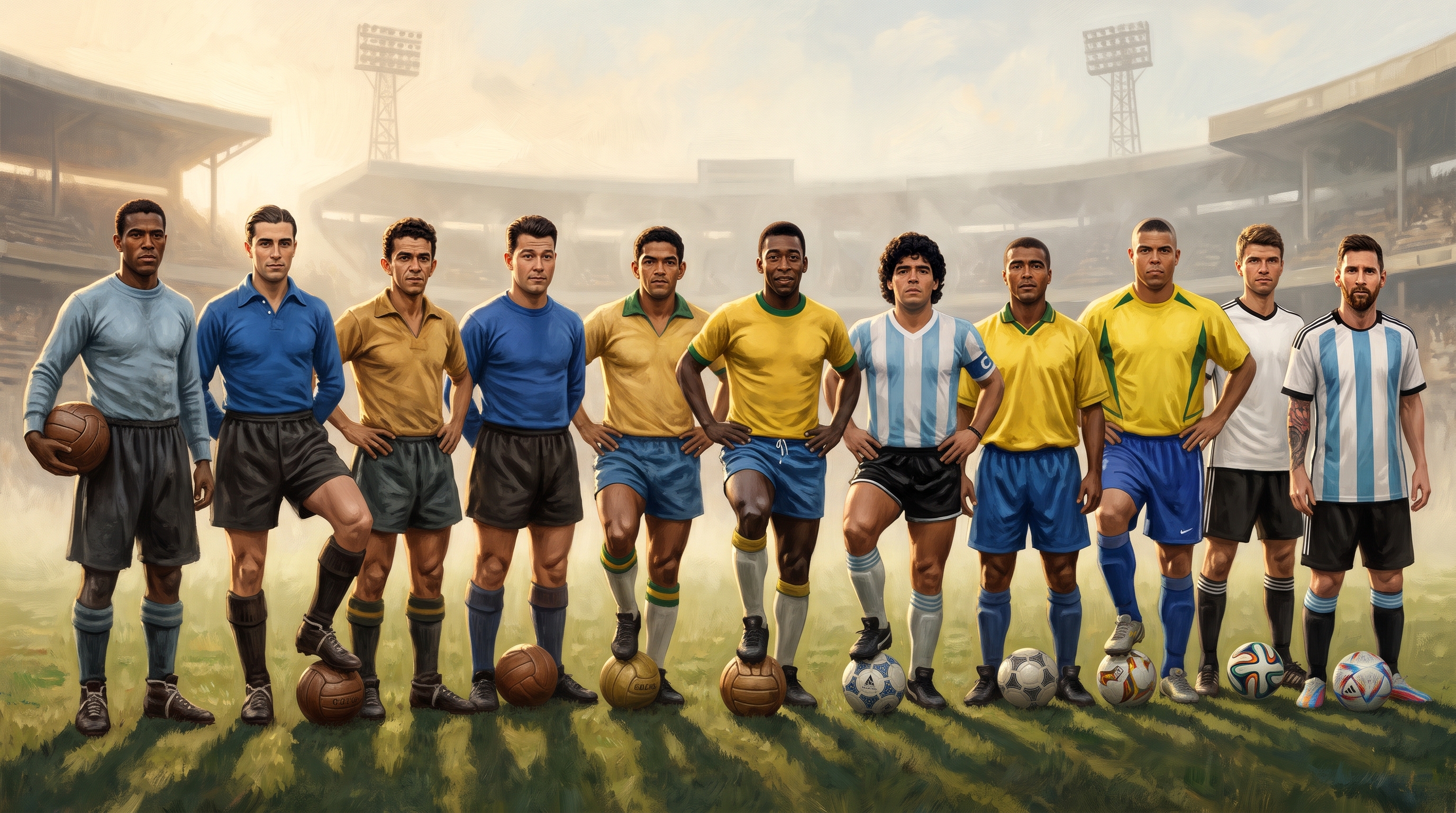
World Cup top scorers by year, ranked by goals and by goals per match
Kylian Mbappé finished the 2026 World Cup with 10 goals in eight matches and became the first player to win the Golden Boot twice, four years after his first in Qatar. His 2 goals in France's 6-4 defeat to England in the third-place match on July 18, 2026 settled the race against Lionel Messi, who stayed on 8.
Ten goals put Mbappé joint third on the list for a single tournament, behind only Just Fontaine and Sándor Kocsis. But the 2026 edition had 104 matches, almost six times the 18 played in Uruguay in 1930, and the semi-finalists played eight games each. Totals and efficiency tell different stories.
So we ranked every World Cup top scorer twice. First by goals, the way it is usually done. Then by goals per match, which is a fairer way to judge them.
World Cup top scorers by year, ranked by goals
FIFA recognises the leading scorer of every edition since 1930 as a Golden Boot winner, even though the trophy was first handed out in 1982 as the Golden Shoe and only took its current name in 2010. That gives 28 players across 23 tournaments. Some lists count 31 because they include the three men who tied Thomas Müller on 5 goals in 2010.
| Pos. | Year | Top scorer | Nation | Goals |
|---|---|---|---|---|
| 1 | 1958 | Just Fontaine | France | 13 |
| 2 | 1954 | Sándor Kocsis | Hungary | 11 |
| 3= | 1970 | Gerd Müller | West Germany | 10 |
| 3= | 2026 | Kylian Mbappé | France | 10 |
| 5= | 1950 | Ademir | Brazil | 9 |
| 5= | 1966 | Eusébio | Portugal | 9 |
| 7= | 1930 | Guillermo Stábile | Argentina | 8 |
| 7= | 2002 | Ronaldo | Brazil | 8 |
| 7= | 2022 | Kylian Mbappé | France | 8 |
| 10= | 1938 | Leônidas | Brazil | 7 |
| 10= | 1974 | Grzegorz Lato | Poland | 7 |
| 12= | 1978 | Mario Kempes | Argentina | 6 |
| 12= | 1982 | Paolo Rossi | Italy | 6 |
| 12= | 1986 | Gary Lineker | England | 6 |
| 12= | 1990 | Salvatore Schillaci | Italy | 6 |
| 12= | 1994 | Oleg Salenko | Russia | 6 |
| 12= | 1994 | Hristo Stoichkov | Bulgaria | 6 |
| 12= | 1998 | Davor Šuker | Croatia | 6 |
| 12= | 2014 | James Rodríguez | Colombia | 6 |
| 12= | 2018 | Harry Kane | England | 6 |
| 21= | 1934 | Oldřich Nejedlý | Czechoslovakia | 5 |
| 21= | 2006 | Miroslav Klose | Germany | 5 |
| 21= | 2010 | Thomas Müller | Germany | 5 |
| 24 | 1962 | Garrincha, Vavá, Leonel Sánchez, Flórián Albert, Valentin Ivanov, Dražan Jerković | Brazil, Chile, Hungary, USSR, Yugoslavia | 4 |
In 2010 David Villa, Wesley Sneijder and Diego Forlán also scored 5 goals, and FIFA gave the award to Müller on assists. FIFA revised two early tallies in 2006, lowering Leônidas from 8 to 7 goals in 1938 and raising Nejedlý from 4 to 5 in 1934.
Read this way, the story is familiar. Fontaine's 13 goals at Sweden 1958 have stood for 68 years, and only Kocsis, the elder Müller and now Mbappé have reached double figures. At the other end, 1962 remains the only tournament where 4 goals were enough to finish top.
Why total goals tell only half the story
The table above treats every tournament as if it were the same competition. It is not. Uruguay 1930 had 13 teams and 18 matches. The field was usually 16 teams until 1978, then grew to 24 in 1982, 32 in 1998 and 48 in 2026, when the schedule reached 104 matches.
A top scorer's chance to play more games grew with it. Leaving aside the six-way tie of 1962, the top scorers from 1930 to 1970 played an average of 5.1 matches. From 1974 onwards the average rose to 6.4, and Mbappé played eight in 2026. A striker in 1930 could play four or five games at most.
Scoring rates moved too, and not always in the same direction. Switzerland 1954 produced 5.38 goals per match, still the highest of any edition. Italia 90 produced 2.21, the lowest. Six goals meant something very different in each.
World Cup top scorers ranked by goals per match
Dividing goals by matches played removes the first distortion. This is the same list, now ranked by efficiency, with a second measure alongside it. That measure is the share of all goals in the tournament that the top scorer scored himself.
| Pos. | Top scorer | Year | Goals | Matches | Goals per match | Share of tournament goals |
|---|---|---|---|---|---|---|
| 1 | Sándor Kocsis | 1954 | 11 | 5 | 2.20 | 7.9% |
| 2 | Just Fontaine | 1958 | 13 | 6 | 2.17 | 10.3% |
| 3= | Guillermo Stábile | 1930 | 8 | 4 | 2.00 | 11.4% |
| 3= | Oleg Salenko | 1994 | 6 | 3 | 2.00 | 4.3% |
| 5 | Leônidas | 1938 | 7 | 4 | 1.75 | 8.3% |
| 6 | Gerd Müller | 1970 | 10 | 6 | 1.67 | 10.5% |
| 7= | Ademir | 1950 | 9 | 6 | 1.50 | 10.2% |
| 7= | Eusébio | 1966 | 9 | 6 | 1.50 | 10.1% |
| 9= | Kylian Mbappé | 2026 | 10 | 8 | 1.25 | 3.2% |
| 9= | Oldřich Nejedlý | 1934 | 5 | 4 | 1.25 | 7.1% |
| 11= | Gary Lineker | 1986 | 6 | 5 | 1.20 | 4.5% |
| 11= | James Rodríguez | 2014 | 6 | 5 | 1.20 | 3.5% |
| 13= | Ronaldo | 2002 | 8 | 7 | 1.14 | 5.0% |
| 13= | Kylian Mbappé | 2022 | 8 | 7 | 1.14 | 4.7% |
| 15= | Grzegorz Lato | 1974 | 7 | 7 | 1.00 | 7.2% |
| 15= | Harry Kane | 2018 | 6 | 6 | 1.00 | 3.6% |
| 17= | Mario Kempes | 1978 | 6 | 7 | 0.86 | 5.9% |
| 17= | Paolo Rossi | 1982 | 6 | 7 | 0.86 | 4.1% |
| 17= | Salvatore Schillaci | 1990 | 6 | 7 | 0.86 | 5.2% |
| 17= | Hristo Stoichkov | 1994 | 6 | 7 | 0.86 | 4.3% |
| 17= | Davor Šuker | 1998 | 6 | 7 | 0.86 | 3.5% |
| 22 | Thomas Müller | 2010 | 5 | 6 | 0.83 | 3.4% |
| 23 | Miroslav Klose | 2006 | 5 | 7 | 0.71 | 3.4% |
| 24 | Garrincha, Vavá, Leonel Sánchez, Dražan Jerković | 1962 | 4 | 6 | 0.67 | 4.5% |
Players level on goals per match are ordered by total goals. Flórián Albert and Valentin Ivanov, the other two joint top scorers of 1962, are left out because their matches played could not be confirmed.
The order changes sharply. Stábile climbs from seventh to third and Leônidas from 10th to fifth. Salenko jumps from 16th to joint third. Ronaldo, eighth by goals, drops to 13th, and Mbappé's 2026 campaign falls from joint third to joint ninth.
The golden age of the two-goal scorer
Kocsis sits at the top. He scored 3 goals against South Korea in a 9-0 win, 4 in an 8-3 rout of West Germany, then 2 against Brazil in the quarter-finals and 2 more against Uruguay in the semi-finals. He failed to score only in the final, which Hungary lost 3-2 to the same West Germany side they had crushed in the group.
Fontaine was even more consistent. He scored in all six of France's matches in 1958 and finished with 4 goals in the 6-3 win over West Germany in the third-place match. Thirteen goals from six games remains the benchmark of the tournament.
Then there is Stábile, who did not even play Argentina's opening match in 1930. He scored a hat-trick on his debut against Mexico, added 2 against Chile and 2 against the United States, and scored in the final that Uruguay won 4-2.
The numbers for the whole era are striking. From 1930 to 1970, again leaving 1962 aside, the eight top scorers combined for 72 goals in 41 matches, a rate of 1.76 per game. The 15 top scorers from 1974 to 2026 managed 97 goals in 96 matches, almost exactly one per game.
Context matters here. Early tournaments threw elite sides against teams with little international experience, and the gap showed in scorelines like Hungary's 9-0. Even so, apart from Salenko, no top scorer since 1970 has averaged more than 1.25 goals per match. The best ratio in World Cup history belongs to someone else entirely. Poland's Ernst Wilimowski scored 4 goals in his only match, a 6-5 defeat to Brazil in 1938.
How dominant was each scorer?
The share of tournament goals measures something different from efficiency. It asks how much of the whole competition revolved around one man's finishing.
Five top scorers took more than 10% of all the goals in their tournament. Stábile scored 11.4% of the goals in 1930, followed by Gerd Müller, Fontaine, Ademir and Eusébio. All five played between 1930 and 1970.
Since 1974, no top scorer has gone above the 7.2% of Lato. Mbappé's 10 goals in 2026 amount to just 3.2% of a record total of 308, the lowest share of any top scorer in history. More matches mean more goals for everyone else, so this measure punishes the modern game as much as raw totals flatter it.
Adjusting for the era
To remove both distortions at once, we built a simple index. It divides a player's goals per match by the average goals scored per team per match in his tournament. An index of 1.00 means the player, on his own, scored at the same rate as an average team.
Only five top scorers clear that mark. Salenko leads with 1.48, ahead of Fontaine (1.20), Gerd Müller (1.12), Eusébio (1.08) and Stábile (1.03). Kocsis falls to 0.82, because Switzerland 1954 was so full of goals, and Leônidas and Ademir drop to 0.75.
Salenko needs a caveat. He played only three matches at USA 1994, and 5 of his 6 goals came in a single 6-1 win over Cameroon. Russia went out in the group stage, which makes him the only Golden Boot winner whose team did not reach the knockout rounds. His figure is real, but it rests on one extraordinary afternoon.
Among modern top scorers, Lineker's 6 goals in five matches at Mexico 1986 give the best index since 1970 apart from Salenko, at 0.95. Ronaldo in 2002 follows at 0.91 and James Rodríguez in 2014 at 0.90.
Where Mbappé's 2026 campaign really ranks
By goals per match, Mbappé's 1.25 in 2026 is the best of any top scorer since Gerd Müller in 1970, once Salenko's three-game tournament is set aside. By era-adjusted index he sits at 0.84, almost identical to his own 0.85 in Qatar and below the great names of the 1950s and 1960s.
The 2026 tournament also changed what a top scorer race looks like. Four players reached 7 goals or more, with Mbappé, Messi, Jude Bellingham and Erling Haaland all getting there. No previous edition had more than two.
What sets Mbappé apart is consistency across tournaments rather than a single peak. He has now scored 22 goals in 22 World Cup matches over three editions, exactly one per game, with 8 or more goals in two separate tournaments.
Who has scored the most World Cup goals overall?
Mbappé is the all-time leading scorer at the World Cup with 22 goals, scored at Russia 2018, Qatar 2022 and the 2026 tournament. He passed Messi, who finished on 21, with his second goal in the third-place match against England. Before them, Miroslav Klose had held the record with 16 goals since 2014.
The verdict
Fontaine owns the record and probably always will. Kocsis owns the best efficiency of any top scorer, and Salenko has the strongest claim once the era is taken into account, although his total comes from just three matches. Mbappé's 10 goals in 2026 were a great campaign rather than the greatest. His real achievement is that he has kept up that level across three World Cups.
Explore more of the numbers behind these campaigns in our all-time World Cup top scorers table, the full record of the 1958 World Cup in Sweden, Salenko's tournament at USA 1994 and the complete story of the 2026 World Cup. For every edition since 1930, start at the World Cup archive.

Carlos Ramón
Football historian and editorial director of Historical Soccer. Specialist in World Cup history, classic tactics, and iconic matches.