World Cup host countries that also won the Tournament
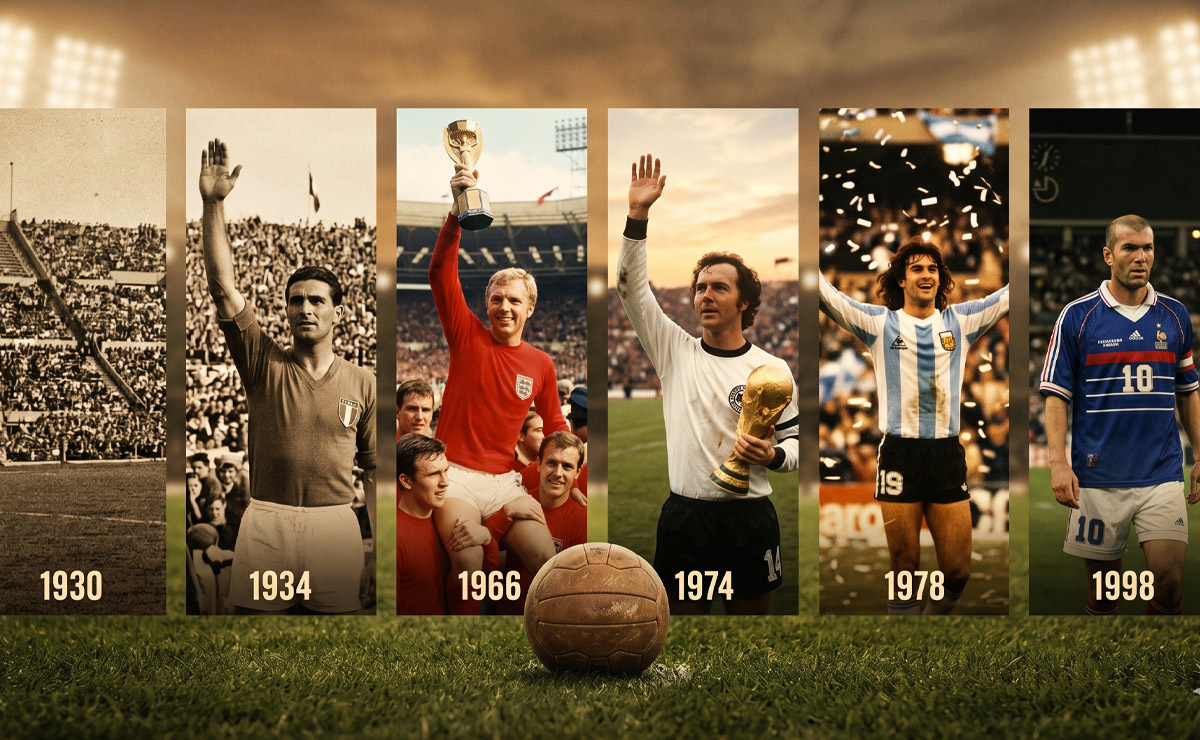
Eighteen countries have hosted the FIFA World Cup since Uruguay staged the inaugural tournament in 1930. Only six of them won it. That is not a coincidence or a curiosity — it is a reminder that home advantage, however real, has never been enough on its own to guarantee anything in a competition this demanding.
The six nations that managed it did so across five decades, in tournaments that ranged from 13 teams to 32, under circumstances that varied wildly in terms of politics, pressure and football history. What they share is rarer than it looks. No country has joined that list since France won on home soil in 1998, and the gap grows wider with every edition that passes.
The six nations that won the World Cup as hosts
Only six times in the history of the tournament has a nation lifted the trophy on home soil. Across 22 editions and 18 different host countries, that number speaks for itself hosting the World Cup is a privilege, but winning it is something far rarer, and the list has not grown since 1998.
| Nation | Year | Final opponent | Score | Teams in tournament |
|---|---|---|---|---|
| Uruguay | 1930 | Argentina | 4–2 | 13 |
| Italy | 1934 | Czechoslovakia | 2–1 (aet) | 16 |
| England | 1966 | West Germany | 4–2 (aet) | 16 |
| West Germany | 1974 | Netherlands | 2–1 | 16 |
| Argentina | 1978 | Netherlands | 3–1 (aet) | 16 |
| France | 1998 | Brazil | 3–0 | 32 |
Uruguay 1930 the founding triumph
The first World Cup was always going to belong to Uruguay. FIFA awarded them the inaugural tournament in recognition of two consecutive Olympic titles and to coincide with the centenary of the country's first constitution. The Estadio Centenario was built specifically for the occasion, and on 30 July 1930, it held 93,000 people for a final that pitted the hosts against their greatest rivals, Argentina.
José Nasazzi led the side with the authority of a man who understood exactly what the moment meant. Uruguay came from 2–1 down at half-time to win 4–2, with Héctor Castro who had lost part of his right forearm in a childhood accident scoring the final goal. There was no trophy lift broadcast around the world, no global television audience, but in Montevideo that afternoon, something new had begun.
Italy 1934 the Fascist shadow
No World Cup has ever been more politically loaded than the one Benito Mussolini staged in Italy. The tournament was explicitly designed as a showcase for Fascist strength, with stadiums, posters and ceremony all pressed into service for the regime. Whether the refereeing reflected that pressure remains debated, but Italy's path to the final was notably physical, and their opponents notably reduced.
Vittorio Pozzo's side beat Czechoslovakia 2–1 after extra time in Rome, with Angelo Schiavio scoring the winner in the additional period. Pozzo remains the only manager to win the World Cup twice he repeated the feat in 1938 in France. The triumph was real, the football often brutal, and the context has never fully left the story.
England 1966 sixty years and counting
Wembley on 30 July 1966 is the fixed point around which all of English football orbits. Alf Ramsey's side pragmatic, organised, built on industry rather than flair defeated West Germany 4–2 after extra time in a final that has been disputed ever since. Geoff Hurst's third goal, the shot that struck the crossbar and bounced somewhere near the line, was given. The debate has never closed.
Bobby Moore lifting the Jules Rimet Trophy remains the defining image of England at a World Cup, because it is the only one of its kind. Sixty years on, that afternoon at Wembley still functions as both the high point and the perpetual reminder of everything the national team has not managed since.
West Germany 1974 the total football final
The great irony of 1974 is that the tournament produced the most celebrated footballing idea of its era Johan Cruyff's Netherlands, playing Total Football in a way that has shaped every tactical conversation since and then watched the hosts dismantle it in the final. West Germany were not the more beautiful side. They were the better-prepared one.
Franz Beckenbauer lifted the trophy at the Olympiastadion in Munich, but the win belonged to a collective. Wolfgang Overath, Gerd Müller and Paul Breitner were at the peak of their powers, and Jupp Heynckes, Sepp Maier and Berti Vogts gave the side a steel that Cruyff's magnificent Netherlands could not match on the day. A golden generation, in the right place at the right time.
Argentina 1978 triumph and controversy
The ticker-tape raining down on the Estadio Monumental in Buenos Aires is one of the iconic images of any World Cup. What surrounds it is harder to look at. The 1978 tournament was held under a military junta that had seized power two years earlier, and the regime used the event with explicit political intent. The football happened inside something deeply wrong.
Mario Kempes was the tournament's outstanding player, and Argentina beat Netherlands 3–1 after extra time in the final. But the match against Peru four days earlier in which Argentina needed a four-goal margin to advance and won 6–0, eliminating Brazil has never been satisfactorily explained. The trophy is real. The shadow has never lifted.
France 1998 the last home winners
Zinedine Zidane headed in twice inside the first 45 minutes, Ronaldo played through whatever had happened to him the night before, and France won 3–0 in a final that felt, for long stretches, more like a coronation than a contest. The Stade de France erupted, and Paris went further still a million people on the Champs-Élysées before midnight, the word champions projected onto the Arc de Triomphe.
Aimé Jacquet's squad had been written off by much of the French press before the tournament. What they became a multicultural side that won together in a way that felt like a statement about the country itself still resonates. That 1998 final was the last time a host nation won the World Cup. Seven tournaments have passed since. The gap grows longer every four years.
Curious facts and patterns across the six home wins
Look at the six wins together and patterns emerge that no individual story makes obvious. Five of them happened before 1980, in a tournament that bore little resemblance to the global event it has since become. Four of the six finals required extra time the host nations grinding through, the crowd carrying them when their legs could not. And since France lifted the trophy in Paris in 1998, seven host nations have tried and every single one has fallen short.
The tournament was smaller then
When Uruguay won in 1930, they beat twelve other nations to do it. When Italy won in 1934 and England in 1966, the field had grown to sixteen still a number small enough that home advantage could genuinely tilt the odds. The elite of world football was a narrower circle, travel was harder, and opponents arrived less prepared than the hosts for the specific conditions of each tournament.
The expansion to 24 teams in 1982 and then to 32 in 1998 changed the arithmetic permanently. More teams meant more elite opponents, longer knockout runs, and a depth of opposition that crowd noise alone cannot neutralise. Winning six consecutive matches against the best sides in the world requires something beyond geography, and the data since 1982 reflects that clearly.
When hosts have failed
The more representative story of hosting a World Cup is not triumph it is the weight of expectation meeting the reality of the draw. Brazil in 1950 lost the deciding match to Uruguay in front of more than 170,000 people at the Maracanã, a defeat so shattering it acquired its own name. Sixty-four years later, the same country hosted again and lost 7–1 to Germany in the semi-finals at Belo Horizonte, another wound that has not fully healed.
| Host | Year | Exit stage |
|---|---|---|
| Argentina | 1978 | Winners |
| Spain | 1982 | Second group stage |
| Mexico | 1986 | Quarter-finals |
| Italy | 1990 | Third place |
| United States | 1994 | Round of 16 |
| France | 1998 | Winners |
| South Korea | 2002 | Fourth place |
| Japan | 2002 | Round of 16 |
| Germany | 2006 | Third place |
| South Africa | 2010 | Group stage |
| Brazil | 2014 | Fourth place |
| Russia | 2018 | Quarter-finals |
| Qatar | 2022 | Group stage |
Since 1998, no host has reached a final. South Africa, Russia and Qatar all exited before the quarter-finals. The failure column is far longer than the success column, and it has been growing in one direction only.
Will it ever happen again
The 2026 tournament will be co-hosted by the United States, Canada and Mexico, three nations sharing the burden and the spotlight across a combined 48-team competition. None of the three enters as a realistic candidate for the title. The USA have never progressed beyond the quarter-finals. Canada have never won a knockout match at a World Cup. Mexico have not gone past the round of 16 in eleven consecutive attempts.
Beyond 2026, the 2030 hosts; Morocco, Portugal and Spain, with centenary matches in Argentina, Paraguay and Uruguay, and the 2034 host Saudi Arabia present no more obvious case for a home winner. The conditions that produced the six names on that list may simply belong to a different era of football, one where the gap between the best and the rest was narrower, and where playing at home meant something the modern game has made harder to quantify. The list of six may not be finished. But it has not moved in 28 years, and there is no strong reason to expect that to change soon.