How VAR Works In Soccer And At The World Cup?
I have spent enough years watching football to know that some changes arrive quietly and others rewrite the entire conversation. VAR belongs firmly in the second category, a system that walked into the sport almost overnight and never really left.
What follows is my attempt to explain it properly, from the basic mechanics referees rely on every weekend to the way it has reshaped three consecutive World Cups. I want this to read like something a fellow fan would actually find useful, not a rulebook nobody asked for.
How VAR works in soccer at its most basic level
I still remember the first time I watched a referee draw a rectangle in the air, and the whole stadium seemed to hold its breath together. That gesture is now as familiar as the whistle itself. What sits behind it is a system built on one simple idea, that a team of officials watching several camera angles can catch what a single referee on the pitch physically cannot.
The four moments VAR can intervene
I always tell people that VAR is not a general appeals process. It only exists for four specific categories, and everything else stays entirely in the hands of the referee on the pitch.
- Goal or no goal, checking for offside, fouls, or the ball leaving play before the ball crosses the line
- Penalty or no penalty, confirming whether contact happened inside the area and whether it was actually an offence
- Direct red card, reviewing serious foul play or violent conduct that the referee may have missed at full speed
- Mistaken identity, correcting a caution or sending off given to the wrong player
I find it telling that these four categories have barely changed since VAR entered the Laws of the Game in 2018. The system was designed narrow on purpose, and that restraint is exactly why it has survived this long without swallowing the sport whole.
Why the referee always has the final word
I think this is the detail people forget most often. VAR can recommend, VAR can flag, VAR can even show the referee three different angles of the same incident. What it can never do is make the decision itself.
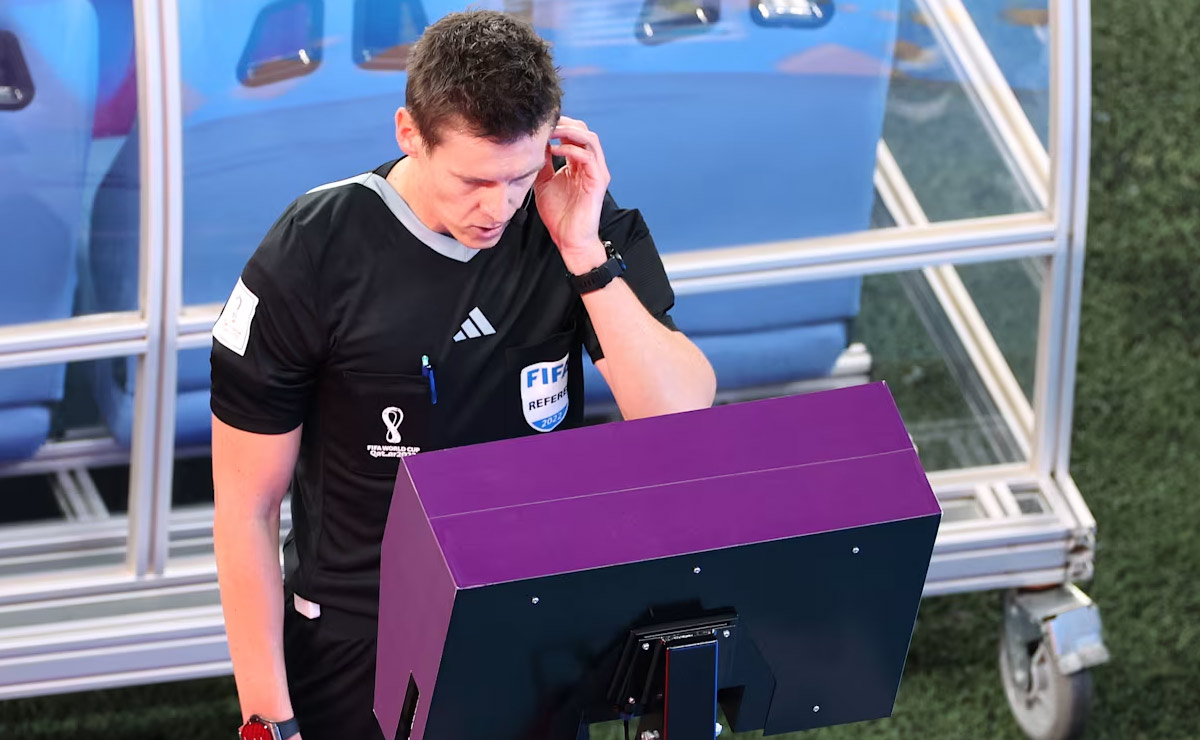
That distinction matters because the whole system was built to protect the authority of the referee rather than replace it. I have watched officials walk to the pitchside monitor, study the replay, and still confirm their original call. Nobody outside the video operation room can force a different outcome.
I suppose that is the quiet genius of it. The technology adds information, but the human being on the grass still carries the weight of the decision, exactly as it has been since the sport began.
How VAR works in soccer differently at the World Cup
I always point out to people that VAR at a World Cup is not quite the same beast as VAR in a domestic league on a random Tuesday night. FIFA runs the entire operation directly rather than delegating it to individual federations, the broadcast production sits under one centralised structure shared across every venue, and the sheer number of nations, languages, and playing styles converging in one tournament changes what the system actually needs to deliver.
VAR at the 2018 World Cup in Russia
I think of 2018 as the moment VAR stopped being a domestic experiment and became a permanent fixture of the sport's biggest stage. The International Football Association Board had only written it into the Laws of the Game that same year, and FIFA chose the World Cup itself, in front of a global audience, to prove the technology could survive the pressure of a tournament rather than a quiet midweek fixture.
What followed reshaped how pundits talked about refereeing entirely. The tournament produced noticeably more penalties than any previous edition, a shift so visible that broadcasters spent entire halftime segments explaining why contact inside the area was suddenly being punished with a consistency nobody had seen before.
I still think of the final in particular whenever someone asks me if VAR really changes outcomes. Ivan Perisic's handball against France led to a VAR reviewed penalty in the biggest match on earth, awarded by referee Nestor Pitana after a pitchside review, and it remains one of the first moments fans point to when they explain what VAR actually looks like in practice.
VAR at the 2022 World Cup in Qatar
I remember 2022 as the tournament where the technology itself took a genuine leap rather than a marginal upgrade. Semi automated offside technology arrived for the first time at a World Cup, tracking limb positions through sensors embedded in the ball and a network of cameras rather than leaving officials to freeze a single broadcast frame and draw lines by eye.
The opening match alone told the whole story of what that shift meant in practice. Argentina had three separate goals ruled out for offside against Saudi Arabia, decisions that would have taken agonising minutes to confirm under the old manual process yet were resolved with a speed and confidence that surprised even seasoned commentators.
I noticed something else that tournament too, one that often gets overlooked. The pace of officiating actually improved even as the underlying technology grew more sophisticated, and for once a new layer of automation made matches feel quicker rather than dragging them into longer stoppages.
VAR at the 2026 World Cup
I find the expanded 48 team format the most significant shift heading into this tournament, simply because of the scale involved. More nations, more group matches, and a longer knockout ladder push the total fixture count past a hundred games, which means far more reviewable moments spread across a much longer competition window than any prior edition has faced.
One genuine rule change stands out among everything else introduced this year. Corner kicks now fall under VAR review when a decision is clearly incorrect and can be corrected without delaying the restart, a category that simply did not exist at any World Cup before this one, and it closes a small but real gap in what officials could previously fix.
I expect fans watching in 2026 to notice this most during tight attacking sequences near the byline, the kind of moment that used to pass without a second look. A wrongly awarded corner that once simply stood will now sit under the same scrutiny reserved for goals and penalties, however brief that particular check tends to be.
The technology behind every VAR decision
I think what surprises casual fans most is how much hardware sits behind a single hand gesture from the referee. A modern World Cup venue carries dozens of cameras positioned across every angle of the pitch, feeding directly into a video operation room where a small team studies incidents in real time rather than waiting for a broadcast replay to catch up.
Inside that room the review process depends entirely on a constant line of communication between the video officials and the referee out on the grass. Every offside line, every contested touch, and every question about where the ball crossed a boundary passes through that same channel before a single word reaches the players.
Common criticisms fans still raise about VAR
I hear the same complaint from supporters in almost every stadium I have followed this system into. A goal celebration freezes mid air while officials study a replay, and something about that pause drains the instinctive joy that used to belong entirely to the moment itself.
Subjectivity remains the harder problem to solve, and I do not think any camera angle fully removes it. Two officials can watch the same contact inside the penalty area and still land on different conclusions, which tells me the technology sharpens the picture without ever settling the argument underneath it.
There is also a quieter frustration that rarely makes the highlight reels. Fans inside the stadium often wait through a review with no real explanation, watching the referee mime a rectangle while the broadcast audience at home already understands exactly what is being checked.
I try to stay careful here, because it would be easy to reach for a tidy statistic about improved accuracy and call the debate settled. Without a verifiable source behind such a figure, I would rather leave the criticism standing on its own weight than dress it up with a number I cannot confirm.
The human element technology was never meant to replace
We have watched this system grow from a hesitant experiment into a permanent fixture of how the biggest tournament in the world settles its most contested moments. What began with a single rectangle drawn in the Russian air now stretches across sensors, semi automated lines, and a room full of officials studying every angle at once. Yet the referee still walks to that pitchside monitor and makes the call alone, exactly as the sport has always demanded. For those who want to see how these decisions have shaped outcomes across every tournament since 1930, our Historical Soccer World Cup section holds the full record, alongside penalty and disciplinary statistics drawn from decades of matches long before any camera could freeze a single frame.