Switzerland vs Algeria Prediction World Cup Preview 2026
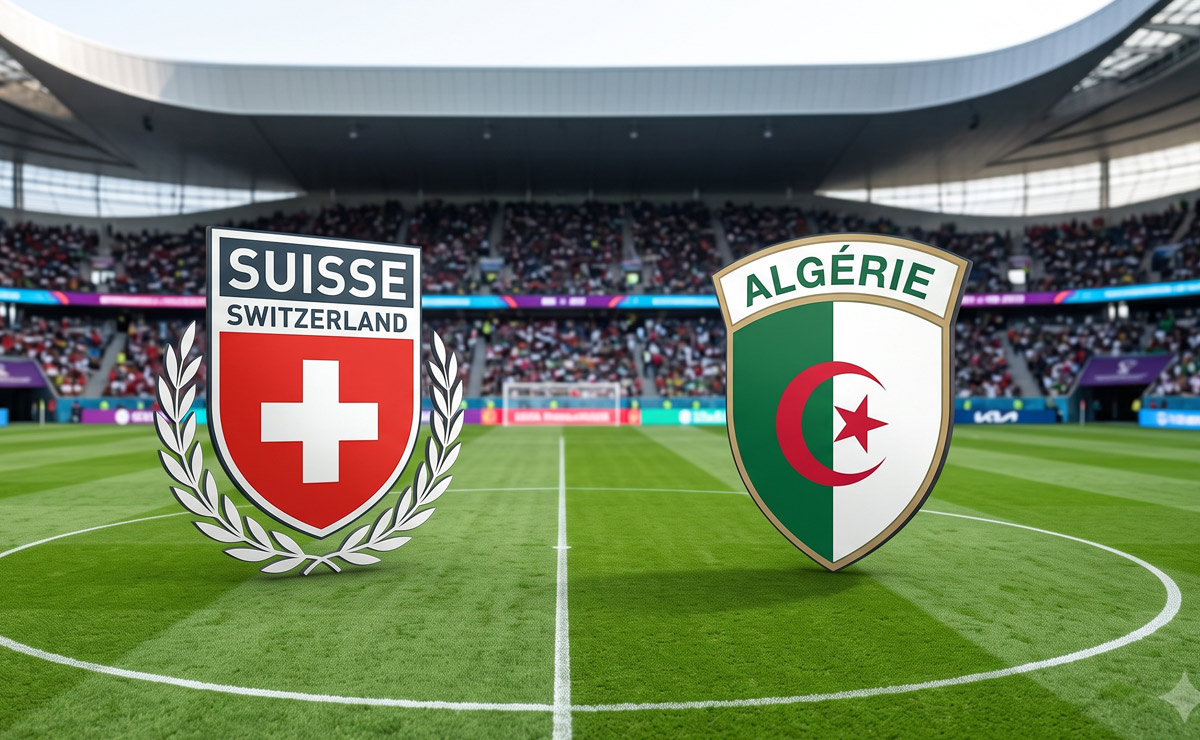
Few round of 32 draws this summer capture the spirit of the World Cup quite like Switzerland against Algeria. One side has built an entire footballing identity on quiet consistency, reaching the knockout rounds so often it barely registers as news anymore. The other carries the memory of one of the tournament's great injustices, a nation still writing its story in flashes of brilliance decades apart. In Vancouver, both threads finally meet.
Switzerland vs Algeria match preview for the World Cup round of 32
The 2026 World Cup round of 32 delivers a fixture built on contrast when Switzerland and Algeria meet in Vancouver on 2 July, in the small hours of 3 July for viewers across Europe and North Africa. One side arrives with the calm efficiency of a nation that treats knockout football as routine business. The other carries the freewheeling unpredictability of a squad that has spent this tournament turning simple equations into drama.
BC Place has already staged several matches at this tournament, and Vancouver's retractable roof stadium adds its own character to a night that will be watched on both sides of the Atlantic.
Switzerland arrive as the tidier of the two sides, topping Group B with seven points from a possible nine. Murat Yakin's team beat Bosnia and Herzegovina, held Qatar to a draw, and closed the group with a controlled win over cohosts Canada. Algeria's route was far messier. A grandstand three all draw with Austria on the final matchday was enough to send Vladimir Petkovic's squad through in third place, arriving with a goal difference of minus two that kept qualification in doubt until the final whistle.
Neither side has much time to dwell on the group stage. The winner in Vancouver moves straight into a round of 16 meeting with either Colombia or Ghana, opponents who will bring an entirely different physical and tactical test.
| Date | Venue | City | Stage | Next round opponent |
|---|---|---|---|---|
| 2 July 2026 | BC Place | Vancouver | Round of 32 | Winner of Colombia vs Ghana |
Reported kickoff times vary slightly by broadcaster and time zone, so exact local start times are best confirmed through official tournament listings.
Switzerland's road to the World Cup 2026 round of 32
Switzerland go into their round of 32 meeting with a squad that treats World Cup qualification the way most nations treat routine business. Six consecutive tournaments and a reputation for discipline over flair have quietly made the Swiss one of the more reliable qualifiers in European football.
Switzerland at the World Cup a long history of knockout football
This is Switzerland's thirteenth World Cup appearance and their sixth in a row, a run of consistency that few European nations can match at this stage of the competition. Their story at the tournament stretches back to 1934, when the Nati reached the quarterfinals in their very first attempt. That achievement was repeated in 1938 and again on home soil in 1954, and it remains the ceiling the country has never broken through since.
Since 1994, the modern era of Swiss football at the World Cup, they have reached the round of 16 in five of six attempts, a level of consistency that borders on remarkable for a nation of under nine million people. Where they have consistently struggled is turning that reliability into anything beyond the first knockout match.
That pattern says something honest about where Switzerland sit in the hierarchy of world football. They are neither pushovers nor genuine contenders, a nation that turns up, competes, and usually leaves after the first knockout round. Breaking that ceiling in Vancouver would be a meaningful marker for this generation, even if it would not yet rewrite the deeper story.
Key figures leading the Swiss squad
Granit Xhaka carries the armband and, at this point, most of the emotional weight of Swiss football too. The Sunderland midfielder is playing in his fourth World Cup, and no other player in the squad commands the dressing room the way he does. When his career eventually ends, it will likely close the book on the last true face of Switzerland's golden generation.
In defense, Manuel Akanji and Nico Elvedi form a partnership built on positioning rather than spectacle, the kind of pairing that rarely makes highlight reels but rarely gets exposed either. Behind them, Gregor Kobel has grown into one of the more composed goalkeepers at this level, comfortable with the ball at his feet and difficult to beat from range.
Further forward, the creative burden falls on Ruben Vargas and Johan Manzambi, two players from very different stages of their careers. Vargas brings the experience of a player who has already scored at this tournament, while Manzambi, still uncapped at senior level until recently, has emerged as one of the most exciting attacking talents to wear the Swiss shirt in years. Between them, they give Murat Yakin's side a directness that the team's reputation for caution does not always suggest.
How Switzerland arrived at the round of 32
Switzerland arrived in Canada already sharp, having beaten Jordan and drawn with Australia in their final warm up matches before the tournament. That form carried directly into Group B, where they opened with a hard fought draw against Qatar before finding their attacking rhythm.
A comprehensive win over Bosnia and Herzegovina followed, with Johan Manzambi scoring twice to underline his growing importance to the side. The result put Switzerland firmly in control of the group with a match still to play.
The decisive moment came against cohosts Canada, a 2 1 win that Vargas and Manzambi both had a hand in, and one that settled first place in Group B beyond doubt. Across the three group matches, Switzerland scored seven goals and conceded only three, a return that reflects both their attacking sharpness and the defensive solidity built around Akanji and Elvedi. Seven points from a possible nine was the reward, and with it, a spot at the top of the group that avoided the toughest runners up path into the round of 32.
Algeria's road to the World Cup 2026 round of 32
Algeria arrive in Vancouver carrying the weight and the romance of Desert Fox football, a team capable of both brilliance and heartbreak in equal measure. Their route to this fixture was chaotic even by their own standards, but few World Cup stories carry as much emotional history as this one.
Algeria at the World Cup two round of 16 appearances decades apart
This is Algeria's fifth World Cup appearance, following campaigns in 1982, 1986, 2010 and 2014, and their first return to the tournament in twelve years. Across those four earlier finals, the Desert Foxes have produced moments that carry far more weight than their group stage exits alone would suggest.
Their only run to the round of 16 came in 2014, when a side built around Islam Slimani and Yacine Brahimi beat South Korea, drew with Russia, and lost narrowly to Belgium before edging through on goal difference. Germany ended that adventure in extra time, but the achievement itself remains the high point of Algerian football at this level.
A win in Vancouver would give Algeria a second round of 16 appearance for the first time in their history, arriving more than a decade after the first and in what feels like an entirely different footballing generation. Few nations get to chase the same milestone twice with such a gap between attempts.
| Nation | World Cup appearances | Best result | Round of 16 reached |
|---|---|---|---|
| Switzerland | 13 | Quarterfinals | 5 times |
| Algeria | 5 | Round of 16 | 1 time |
Switzerland's tally includes their 2026 appearance and reflects a nation that qualifies with far greater regularity than Algeria has managed across its history.
Key figures leading the Desert Foxes
Riyad Mahrez captains this Algeria side and remains its most recognizable face, the last true link to the golden generation that won two Africa Cup of Nations titles under his leadership. At thirty five, he is playing what will almost certainly be his final World Cup, and he has responded with two goals in the group stage that suggest the moment has not yet passed him by.
Houssem Aouar has quietly become the engine of this team, dropping into a deeper midfield role to dictate tempo rather than simply create from the final third. His assists for both of Mahrez's goals against Austria showed exactly what Vladimir Petkovic wants from him in that position.
Rafik Belghali has emerged as the breakout name of this campaign, a right back capable of pushing forward and adding an attacking dimension few expected from the position. The one significant shadow over the squad is Mohamed El Amine Amoura, whose fitness remains a doubt heading into Vancouver, a blow that would force Petkovic to lean even harder on his more experienced options.
How Algeria arrived at the round of 32
Algeria arrived at the tournament full of confidence, having beaten both Netherlands and Bolivia in their final warm up fixtures before the finals. That form did not carry over immediately, though, as Group J handed them a brutal opener against Argentina.
A three nil defeat to the defending champions, inside which Lionel Messi scored a hat trick, left Algeria needing a response fast. They found it against Jordan, grinding out a two one win that kept their round of 32 hopes alive heading into the final matchday.
What followed was one of the most dramatic matches of the entire group stage, a three three draw with Austria that had both sets of players fully aware a point would be enough to send them through. The result left Algeria level with Austria on four points, and it was goal difference, sitting at minus two, that ultimately decided who advanced in which position. Third place was not glamorous, but it was enough, and it set up a round of 32 date with a Swiss side that qualified with far less drama.
Switzerland vs Algeria head to head record
Switzerland and Algeria arrive in Vancouver with almost no shared history to draw from. Their paths have crossed only twice before, both times in low key friendlies played decades apart, and neither has left much of a mark on either nation's collective memory.
The first meeting came in November 1983, a friendly that ended in a two one win for Switzerland. It was a routine fixture between two federations testing squads outside any tournament context, the kind of match that rarely gets remembered beyond a line in a record book.
Switzerland won again in May 1986, this time two nil, completing a modest but clean head to head advantage heading into the modern era. Algeria have never beaten Switzerland in the two occasions they have met.
What makes Vancouver different is the stage. Neither of those earlier friendlies carried any weight beyond preparation, and the two nations have never once met at a World Cup. Whatever happens on the pitch, this round of 32 clash writes a new and far more meaningful chapter into a rivalry that barely exists yet.
| Date | Result | Competition |
|---|---|---|
| November 1983 | Algeria 1 Switzerland 2 | Friendly |
| May 1986 | Algeria 0 Switzerland 2 | Friendly |
What history says about this Switzerland vs Algeria clash
Beyond the group stage tables and injury updates, this fixture carries two historical threads that rarely get mentioned in the same sentence. One team is defined by an infamous injustice that still stings decades later, the other by a knockout drought that has quietly become one of football's stranger records.
Algeria and the ghosts of 1982
Algeria's World Cup story cannot be told without returning to Gijon in 1982, the tournament where Rabah Madjer and Lakhdar Belloumi inspired a stunning two one win over reigning European champions West Germany. It remains one of the great World Cup upsets, the first time an African nation had beaten a European champion at the tournament, and it should have been the springboard for something historic.
Instead, the final group match between West Germany and Austria produced one of football's most notorious results. Both nations knew a narrow West German win would send them through at Algeria's expense, and West Germany duly won one nil in a match so transparently arranged that commentators openly criticized it as it happened. Algeria, who had already finished their own fixtures, could only watch.
That single result eliminated Algeria on goal difference alone, despite their historic win, and the fallout was significant enough that FIFA changed the rules so that final group matches are now played simultaneously. Every Algerian knockout run since, including the one they are chasing in Vancouver, gets read through the lens of that stolen chance.
Switzerland's long wait for a knockout win
Switzerland's own historical thread runs in the opposite direction. Their last win in a World Cup elimination match came in 1938, when a replay victory over Germany sent them into the quarterfinals in only their second appearance at the tournament. Every knockout match since has ended in defeat, whether by a single goal, a penalty shootout, or extra time heartbreak.
What makes the drought stranger is how consistent Switzerland have become at reaching that stage in the first place. Since 1994, they have qualified for the knockout rounds five times in six attempts, a record that would suggest a team comfortable with pressure. Instead, each appearance has produced a new and different way to lose.
Breaking that streak in Vancouver would mean more to this Swiss generation than the scoreline alone could ever capture. It would end a wait that has outlasted entire careers, and it would finally match the team's modern reliability with a result to match it.
Switzerland vs Algeria prediction and odds for the round of 32
Every number available ahead of this fixture points toward a genuinely close contest rather than a formality. Sportsbooks, prediction markets, and statistical models all land in a similar place, which makes this one of the more honestly priced round of 32 matches on the schedule.
What the odds and prediction markets say
DraftKings prices Switzerland at plus one hundred to win in regulation, with Algeria out at plus two seventy five and the draw sitting at plus two thirty. Those numbers describe a favorite without describing a formality, and the gap between the three outcomes is narrower than the group stage results alone might suggest.
Prediction markets tell a very similar story from a different angle. Kalshi traders have Switzerland at 52 percent to win, the draw at 28 percent, and Algeria at 22 percent, a spread that treats this as a legitimate three way contest rather than a lopsided expectation.
What stands out most is how closely the sportsbooks and the prediction markets agree with each other. Dimers' own model lands almost exactly in that same range, giving Switzerland 49.5 percent, Algeria 26 percent, and the draw 24.5 percent. When independent pricing sources converge this tightly, the uncertainty they describe tends to be real rather than a gap waiting to be exploited.
| Market | Switzerland | Draw | Algeria |
|---|---|---|---|
| DraftKings moneyline | plus 100 | plus 230 | plus 275 |
| Kalshi prediction market | 52 percent | 28 percent | 22 percent |
| Dimers model | 49.5 percent | 24.5 percent | 26 percent |
Our prediction for the match
Switzerland's underlying numbers from the group stage are difficult to argue with. Seven goals scored, three conceded, and top spot in Group B secured with a match to spare all describe a team playing within itself rather than one riding good fortune. Algeria's numbers tell a rougher story, a heavy defeat to Argentina followed by a must win response and a draw that could easily have broken the other way.
The experience gap between these two squads at major tournaments is real, even if individual Algerian quality can occasionally erase it for a moment. Xhaka alone carries more World Cup knockout experience than most of the Algeria squad combined, and composure of that kind tends to matter most when a match tightens up late.
Weighing the group stage form, the near absent head to head history, and the balance of the markets together, Switzerland look like the side better equipped to see out a tense night in Vancouver. Algeria have shown enough already in this tournament that a goal or two feels likely, but Swiss defensive organization should be the difference. Our call is a two one win for Switzerland, with Embolo or Vargas the most probable source of the decisive goal.